


Open letter of institutions of historical and political education
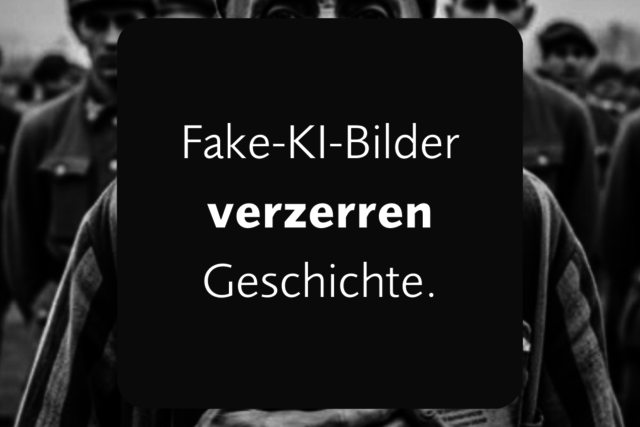
In recent months, social media networks have seen a surge in content that relates to National Socialism created using artificial intelligence (AI). This content does not accurately depict historical events; rather, it is entirely fabricated. This content, colloquially referred to as AI slop, shows supposed situations in Nazi concentration camps or during their liberation. These paint an extremely distorted and false picture. For example, AI-generated images are circulating that show an alleged reunion between prisoners and liberators, or fictional scenes of crying children behind barbed wire. Artificial intelligence is used here to create content made up of fragments of historical facts and emotionalized fiction.
There are different motives behind this content. On the one hand, so-called "content farms" use the emotional impact of the Holocaust to achieve maximum reach with minimal effort. This is a business model based on clicks and advertising revenue. On the other hand, this content is used specifically to dilute historical facts, shift victim and perpetrator roles, or spread revisionist narratives. The platforms' algorithms favor emotionally charged content, regardless of its truthfulness.
As institutions of historical and political education, we observe this development with great concern. AI-generated content distorts history by minimising and trivialising it. It changes the viewing habits of users, who increasingly question even authentic historical documents. Each of these posts devalues the work and undermines the credibility of memorial sites, archives, museums and research institutions.
We are committed to a digital public sphere in which survivors of Nazi persecution and their descendants are protected from having their life stories exploited by strangers for profit. Historical sources and scientific research must not be supplanted by mass AI-generated content. We want real voices and diverse perspectives to be heard.
We are not opposed to digital forms of remembrance and communication. Artificial intelligence can also be used effectively in historical and political education. However, the challenge for society as a whole is to develop ethical and historically responsible standards for this technology. Platform operators have a particular responsibility in this regard. They must ensure that the suffering of victims is not trivialized by emotionalized fiction.
We call on platform operators to:
- Proactively combat AI content that distorts history. Not only in response to user reports.
- Make content that distorts history reportable as misinformation via internal reporting systems.
- Exclude accounts that disseminate such content from all monetization programs.
- Label AI-generated content, without exception, and remove it from the platform if the labeling requirement is violated.
- Work with memorial sites, archives, and experts to improve detection systems for Holocaust-related misinformation.
Initial signatories (in alphabetical order):
Arbeitsgemeinschaft KZ-Gedenkstätten:
- Gedenkstätte Bergen-Belsen
- Gedenkstätte Buchenwald
- KZ-Gedenkstätte Dachau
- KZ-Gedenkstätte Flossenbürg
- KZ-Gedenkstätte Mittelbau-Dora
- KZ-Gedenkstätte Neuengamme
- Mahn- und Gedenkstätte Ravensbrück
- Gedenkstätte und Museum Sachsenhausen
Arolsen Archives
Dokumentations- und Informationszentrum (DIZ) Emslandlager
Dokumentationszentrum NS-Zwangsarbeit
Gedenk- und Bildungsstätte Haus der Wannsee-Konferenz
Gedenkstätte Hadamar
Gedenkstätte in der JVA Wolfenbüttel
Gedenkstätte Lager Sandbostel
Gedenkstätten Gestapokeller und Augustaschacht e.V.
Gedenkstättenreferat der Stiftung Topographie des Terrors
Jüdisches Museum Berlin
KZ-Gedenk- und Begegnungsstätte Ladelund
Netzwerk Digital History und Memory
Sprecher*innenrat des Netzwerks der Gedenkstätten und Erinnerungsinitiativen an Orten ehemaliger NS-Kriegsgefangenenlager
Ständige Konferenz der NS-Gedenkorte im Berliner Raum:
- Denkmal für die ermordeten Juden Europas
- Gedenkstätte und Museum Sachsenhausen
- Gedenk- und Bildungsstätte Haus der Wannseekonferenz
- Gedenkstätte Deutscher Widerstand
- Topographie des Terrors
Stiftung Bayerische Gedenkstätten
Stiftung Hamburger Gedenkstätten und Lernorte zur Erinnerung an die Opfer der NS-Verbrechen
Stiftung Gedenkstätten Buchenwald und Mittelbau-Dora
Stiftung Niedersächsische Gedenkstätten
Verband der Gedenkstätten in Deutschland e.V.
Signatories (in alphabetical order):
Arbeitsstelle Holocaustliteratur, Justus-Liebig-Universität Gießen
Ausstellung "Auf der Spur europäischer Zwangsarbeit. Südniedersachsen 1939–1945"
Denkort Bunker Valentin
Deutsches Exilarchiv 1933-45 der Deutschen Nationalbibliothek
Erinnerungs-, Bildungs- und Begegnungsstätte Alt Rehse
Erinnerungs- und Lernort „Halle 116“
Fritz Bauer Institut
Gedenkhalle Oberhausen
gedenkplaetze.info
Gedenkstätte Berlin-Hohenschönhausen
Gedenkstätte Breitenau
Gedenkstätte für Zwangsarbeit in Leipzig
Gedenkstätten Brandenburg an der Havel
Gedenk- und Dokumentationsstätte KZ Drütte
Geschichtswerkstatt Göttingen e.V.
Hannah-Arendt-Institut für Totalitarismusforschung
Historisches Museum Bremerhaven
Institut für die Geschichte der deutschen Juden
KZ-Gedenkstätte Moringen
Lern- und Gedenkort Schloss Hartheim
NS-Dokumentationszentrum Köln
NS-Dokumentationszentrum München
Projekt “Zwangsarbeit 1939-1945”
Stiftung Erinnerung, Verantwortung und Zukunft (EVZ)
Stiftung Gedenkstätte Esterwegen
Stiftung Sächsische Gedenkstätten
Verein Merkwürdig – Zeithistorisches Zentrum Melk
Zentrum für Holocaust-Studien am Institut für Zeitgeschichte München–Berlin