

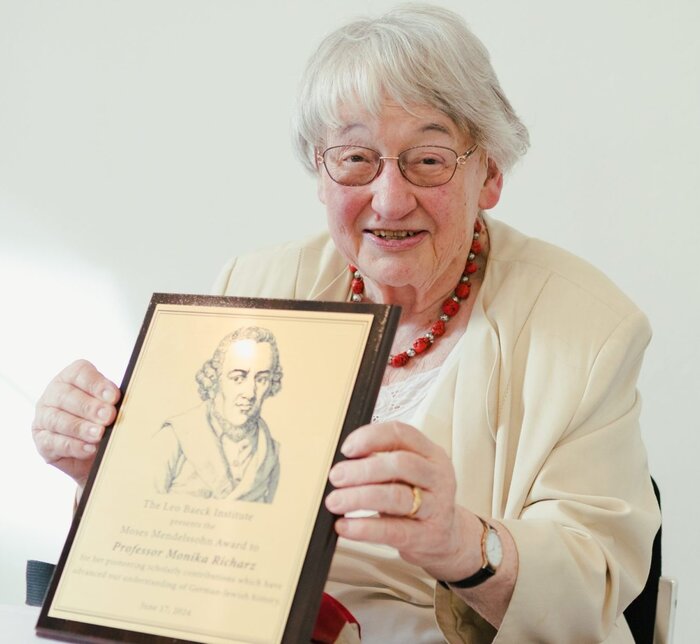
Prof. (em.) Dr. Monika Richarz is a pioneer in researching German-Jewish history, a recipient of the Leo Baeck Institute’s Moses Mendelssohn Award, and former director of the Institute for the History of the German Jews (IGdJ). Thanks to her generous donation, the Monika Richarz-Fonds – Research on Early Modern Jewish History was established at the IGdJ, with the aim of stimulating new research into German-speaking Jewry.
The IGdJ regularly publishes calls for funding applications through the Monika Richarz-Fonds. The funding scheme explicitly encourages research into the Jewish early modern period, an era in which significant demographic, religious, social, political and cultural developments took place and which saw fundamental changes in Jewish life. In addition to developments within Jewish communities, this period is also characterised by profound shifts in the status of Jews within different states and societies. These include, amongst other things, the policies towards Jews and anti-Jewish legislation of individual rulers, anti-Jewish sentiment within the Churches, as well as Christian-Jewish exchange and the emergence of economic and intellectual networks.
The Monika Richarz-Fonds – Research on Early Modern Jewish History aims to support innovative research questions and new methodological approaches. Emphasis is also placed on the exploration of sources, including, in particular, the sources from Jewish communities held in the State Archives of the Free and Hanseatic City of Hamburg.
There is currently no call for applications. Information on applying for funding from the Monika Richarz Fund will be published at a later date.
The following projects are supported by the Monika Richarz-Fonds – Research into the Jewish Early Modern Period:
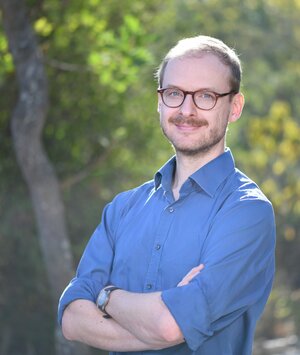
Dr. Johannes Czakai is a historian and post-doctoral researcher at The Hebrew University of Jerusalem (The Martin Buber Society of Fellows und Franz Rosenzweig Minerva Research Center for German-Jewish Literature and Cultural History). After studying in Berlin, Potsdam, and Krakow, he initially worked as a research associate at the Selma Stern Center for Jewish Studies Berlin-Brandenburg. In 2020, he completed his doctorate at the Institute for East European Studies at Freie Universität Berlin. His research interests and areas of focus include the early modern period, names, conversions, genealogy, espionage, and art and sepulchral culture.
His dissertation Nochems neue Namen. Die Juden Galiziens und der Bukowina und die Einführung deutscher Vor- und Familiennamen 1772–1820 [Nochem’s New Names: The Jews of Galicia and Bukovina and the Adoption of German First and Family Names, 1772–1820], was published in 2021 in the IGdJ book series ‘Hamburger Beiträge zur Geschichte der deutschen Juden’ and received numerous awards, including the Hedwig Hintze Prize of the Association of German Historians (VHD). He subsequently worked together with literary scholar Dr. Kathrin Wittler on the research project Joel Jacoby (1811–1863): A Turncoat of the Era of Emancipation and Restoration, funded by the Gerda Henkel Foundation.
Project: Border Crossers and Neighbours. Jewish-Christian Conversions in Early Modern Silesia (1600–1812)
In my book project, I examine the history of early modern Silesia through the lens of conversions of Jews to Christianity. The aim is to study Jewish life and Jewish-Christian conversions in a confessionally mixed region shaped by various geographic and cultural boundaries. With a particular microhistorical focus, the project will highlight selected individual life stories in order to make visible overarching structural processes of change in this border region between cultures, languages, and religious denominations, and to underscore Silesia’s role as a link between East and West.
Support from the Monika Richarz-Fonds enables me to undertake important research trips to archives in, among other places, Frankfurt am Main, Wrocław, and Philadelphia, whose source holdings are essential to my research project. In addition, given the affiliation of the Monika Richarz-Fonds with the IGdJ, I look forward to my exchange with colleagues at the Institute to advance the digital humanities dimension of my project, in particular with regard to the databases I have created.

Dr. Magdaléna Jánošíková is Assistant Professor of Jewish Studies at the University of Amsterdam (UvA), where they teach in the MA Jewish Studies program, BA Hebrew Studies program, and are involved in the development of the undergraduate program. They are a co-convenor of the Empowering Language platform at UvA, which seeks to advocate for and promote the importance of language learning in the age of AI. A historian of European Jewry between 1550 and 1800, they work on the history of knowledge, the body, health and medicine, and on the materialities of text and archive, across the Hebrew, Latin, Yiddish, German, Polish, and Ruthenian corpora of early modern Europe. They received their doctorate from Queen Mary University of London (2020) and subsequently held postdoctoral positions at Ben-Gurion University of the Negev in the ERC project ‘Jewish Translation and Cultural Transfer in Early Modern Europe’, led by Iris Idelson-Shein, received a Polonsky Academy Fellowship at the Van Leer Jerusalem Institute, and the Primo Levi Fellowship at the Katz Center for Advanced Judaic Studies, University of Pennsylvania.
Publications include articles in Isis, The Jewish Quarterly Review, and The European Journal of Jewish Studies. They co-translated Eliezer Eilburg: The Ten Questions and Memoir of a Renaissance Jewish Skeptic (with Joseph M. Davis; Hebrew Union College Press, 2020), and guest-edited a special issue on premodern Jewish healthcare in The Journal of Jewish Thought and Philosophy (2025, with Andrea Gondos). They are currently completing their first monograph Odd Man Out: Jewish Physicians, Medical Labour, and Text in Late Renaissance Europe.
Project: Epistemic Agency and Crisis in Early Modern German Jewry. Hazard, Authority, and the Construction of Expertise, c. 1550–1750
With the support of the Monika Richarz-Fonds, I will examine how Ashkenazi communities in the German lands came to authorize knowledge about the body: who could be trusted to handle whose body, on what grounds, and with what consequences when that trust failed. Rather than asking which Jews attained expertise through extra-Jewish institutions, and thereby treating the university as the threshold event of Jewish knowledge, the project asks how Jewish communities and their members constituted, contested, and transmitted expertise on their own terms, and how these terms reflect the changing norms concerning evidence, testimonies, and facts. Hazard—epidemic, obstetric, iatrogenic—serves as the lens through which these cultures of knowing become legible.
Hamburg, Altona, and Wandsbek offer the densest documentary record for this inquiry: the contracts, ordinances, and case records governing physicians, barber-surgeons, midwives, and other body-workers preserved in the Staatsarchiv Hamburg and the AHW holdings, read alongside the polemical literature that turned Jewish practitioners into public suspects at precisely the moment when licit and illicit practice were newly codified by the civic medical order. Thanks to the support of the Monika Richarz-Fonds parts of this work can be pursued in Hamburg institutions, whose holdings allow the transregional Amulettenstreit of 1750–1751 to be read not only as a theological and cultural rupture but as the culmination of a century-long Ashkenazi practice of examination, attestation, and public adjudication.
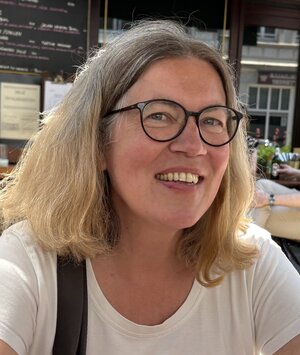
Dr. Uta Lohmann studied Jewish Studies and German Studies at the University of Freiburg, Freie Universität Berlin and The Hebrew University of Jerusalem. After completing her Master’s degree, she worked for the Berliner Festspiele and the Centre for Research on Anti-Semitism before becoming a research assistant at Universität Hamburg on an educational research project focusing on the historical reconstruction of the Berlin Jewish Free School. Among other things, she was involved in editorial projects on educational treatises by Jewish Enlightenment thinkers.
Uta Lohmann wrote her doctoral thesis on the Jewish Enlightenment thinker David Friedländer. Following her doctorate, she led the project ‘Analysis of the Relationships between the Haskalah and Neo-Humanism, Edition of David Friedländer’s Educational Writings and his Correspondence with Wilhelm von Humboldt’, which was funded by the German Research Foundation (DFG). Together with Dr. Kathrin Wittler, she led the edition project Joel Bril Löwe: The Breslau School Writings in Context, also funded by the DFG, from 2020 to 2024. In 2019 and 2020, she was a fellow at the Maimonides Centre for Advanced Studies at the University of Hamburg, and in 2022/23 a visiting research fellow at the Franz Rosenzweig Minerva Research Centre for German-Jewish Literature and Cultural History at the Hebrew University of Jerusalem. Uta Lohmann is co-editor of the series Jewish Educational History in Germany.
Project: Moses Mendelsohn and the Haskalah in Hamburg (exhibition and research project)
This exhibition and research project not only pays tribute to one of the most significant philosophers of the late German Enlightenment and the most prominent figure of the Haskalah, the Jewish Enlightenment. It also aims to examine Mendelssohn’s diverse friendships and family ties to Hamburg and to bring these to the attention of the wider public. The objects brought together in the exhibition will narrate and illustrate this specific chapter of Hamburg’s history, placing it within the context of the Jewish Enlightenment movement and early Reform Judaism.
A central aim is also to convey the significance of the Haskalah as a Jewish modernisation and educational movement with trans-regional networks, which, originating in Berlin, also influenced Jewish intellectual life in the Hamburg area. As part of the exhibition’s development, these influences and repercussions will be researched in detail. The aim is also to highlight that Reform Judaism, which emerged in Hamburg, had its roots in the Haskalah – aspects that have so far been largely overlooked in academic research
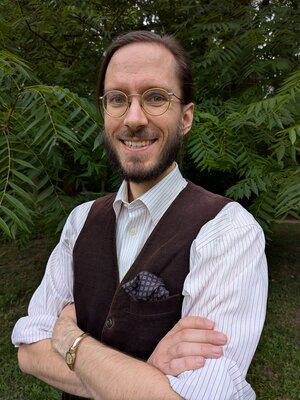
Tim Friedrich Meier M.A. studied Modern and Contemporary History and Philosophy at the University of Leipzig. He is a PhD Candidate at the Lehrstuhl für Neuere und Neuste Geschichte der Martin-Luther-Universität Halle-Wittenberg. In addition, he works as a political education officer at the Ariowitsch-Haus Jewish Cultural and Community Center in Leipzig.
Project: From an instrument of power to an issue of public debate: Jews and their political significance in Prussia between the absolutist state and the enlightened public sphere (1671–1786)
In my dissertation, I examine how Jewish emancipation developed into a central political issue of 19th century bourgeois society. The first elements of both pro-Jewish liberalism and secular antisemitism emerged in the complex negotiations of Prussia’s absolutist policy towards Jews. From 1671 onwards, a secular negotiation style developed between rulers, state officials, estates and the Jewish community. It was oriented towards political and economic benefits while allowing religious arguments only in a hidden way. From 1781 onwards, Christian Wilhelm Dohm, Moses Mendelssohn and other publicists catapulted this political discourse into the broader public sphere of the Enlightenment, thereby transforming the political status of Jews from an internal matter of state administration into a hotly contested proxy debate regarding the future of the emerging bourgeois society. However, by linking the future of the Jews to that of society as a whole, they also prompted their opponents to re-legitimize the traditional religious hostility toward Jews using economic, fiscal, culturalist, and racial arguments, and to tie it to their authoritarian concepts of state and society. In doing so, they laid the groundwork for modern antisemitism as a ‘cultural code’ (S. Volkov) of an exclusionary German society.
My study traces this long trajectory from the power struggles and economic conflicts of absolutism to the widely debated political issue of Jewish emancipation, mapping the argumentative strategies used by various actors to legitimize their positions within their respective political and economic framework. It demonstrates not only how Dohm and his allies undermined the centuries-old practice of excluding Jews by employing Enlightenment ideas, but also how the latent hostility toward Jews adapted to this critique, ultimately laying claim to rationality and Enlightenment values itself.