

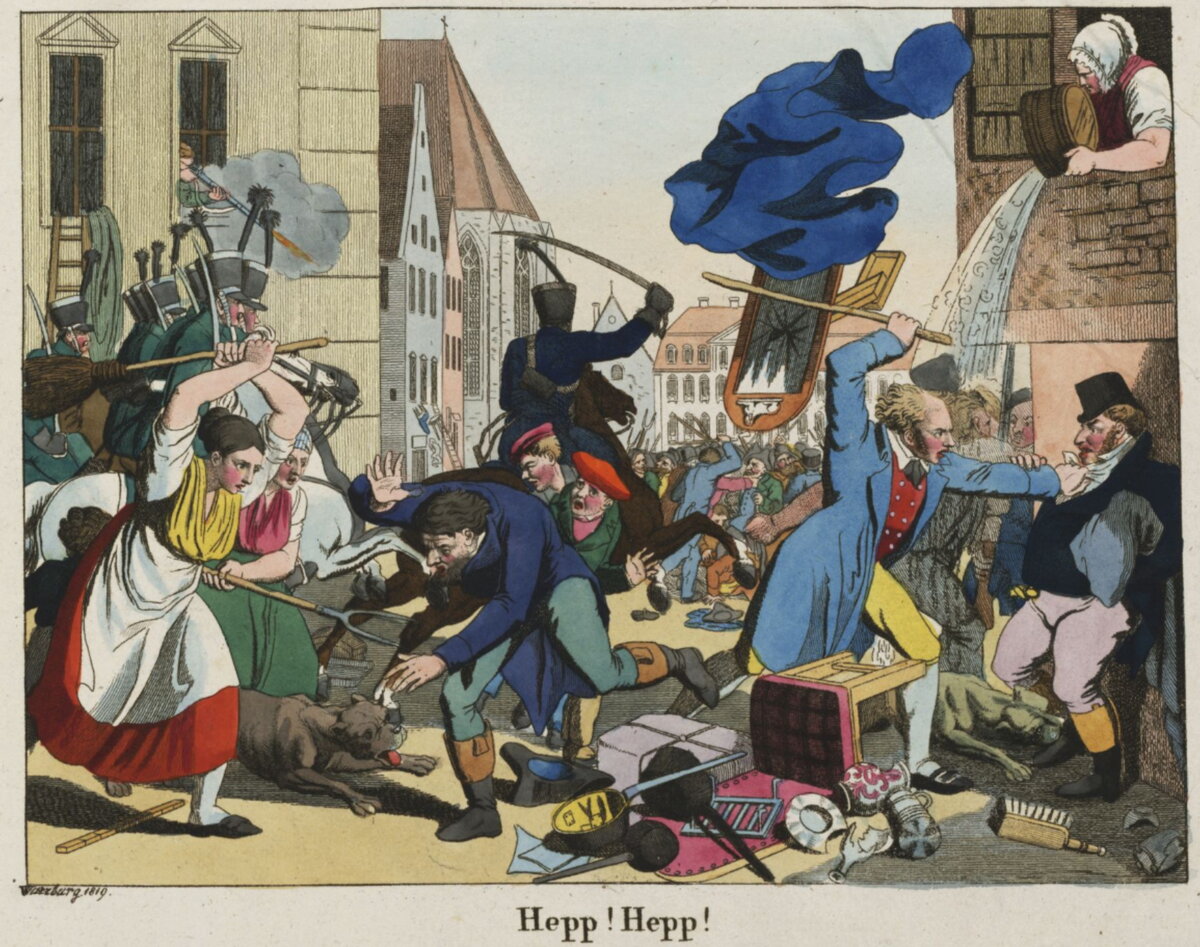
A pogrom rarely came as a surprise. Both the timing and the sequence of events in these violent escalations were highly ritualised – academic research even refers to a ‘pogrom script’, a veritable script for pogrom violence. For example, since the Middle Ages, holidays such as Easter and Passover had been predictable times for violent attacks on Jewish men and women. The announcement of and talk about an impending pogrom already constituted an essential phase of the violent undertaking. They intimidated the Jewish population, drove a wedge between Jewish and non-Jewish neighbours, and whipped the future attackers into a violent frenzy. In contrast to a sudden raid, a central characteristic of the pogrom was therefore life spent in a phase of concrete anticipation.
This sub-project of the research group „Gewalt-Zeiten. Temporalitäten von Gewaltunternehmungen“ specifically examines these Jewish expectations of the pogrom. In what ways did Jewish communities anticipate this specific form of violence? How was the period between the first rumours and the predicted moment of the outbreak of violence used to mitigate its consequences? And how could the harrowing experience be translated into effective defensive measures? For the anticipation phase was by no means merely a period of anxious waiting. It could also be a period of opportunity, during which those under threat, drawing on past experiences, actively prepared for the impending violence through delay, negotiation and tangible resistance. The perpetrators, in turn, experienced time in an entirely different way; they acted on a far shorter timeframe and in a more situational manner.
These practices are examined on the basis of three waves of pogroms in the Russian Empire at the turn of the 20th century, as well as outbreaks of anti-Jewish violence in Germany during the 1920s and 1930s. The analysis assumes that the anticipation of violence changed over time and could also vary depending on the social milieu. Zionists, for example, no longer wished to endure anti-Jewish violence but sought to take their fate into their own hands. Continuing the militant tradition of the Maccabees, they organised their self-defence. Elsewhere, attempts were made to mitigate the expected damage caused by the pogrom through negotiations and financial offers before it had even begun.
The specific form of anticipation will also be examined as a result of earlier experiences of pogroms, which need not necessarily have been their own. For instance, the Eastern European pogroms contributed to a massive wave of migration to Western Europe, particularly to Germany. Around 20 per cent of the Jews living here after the First World War had such a migratory background. The research project examines the extent to which a transfer of experience took place in this context, and how this altered the nature of German Jews’ anticipation of violence.
The research project by Ilay Halpern M.A. focuses on the anticipation of pogrom violence and possible (dis)continuities in the understanding of violence, examining three phases of pogroms between 1881 and 1921. An important source for this research is the Elias Tcherikover Archive, which contains a wealth of contemporary reports on these acts of violence and is now housed at the YIVO Institute in New York. In collaboration with the project leaders Prof. Dr Monica Rüthers and Dr Kim Wünschmann, both settings will also be analysed comparatively with regard to the temporal patterns of interpretation among Jewish actors in the East and West, including both Zionists and non-Zionists.
The research project is organising an international conference on the theme ‘Experiences of Violence and Notions of Temporality in Jewish History’ at the Warburg-Haus in Hamburg from 27 to 29 March 2023. The deadline for applications was 31 August 2022. Click here for the Call for Papers.
![[Translate to English:]](/fileadmin/_processed_/4/a/csm_buecher_49dd995fd3.jpg "[Translate to English:]")